Why Your Dryer Keeps Tripping the Breaker
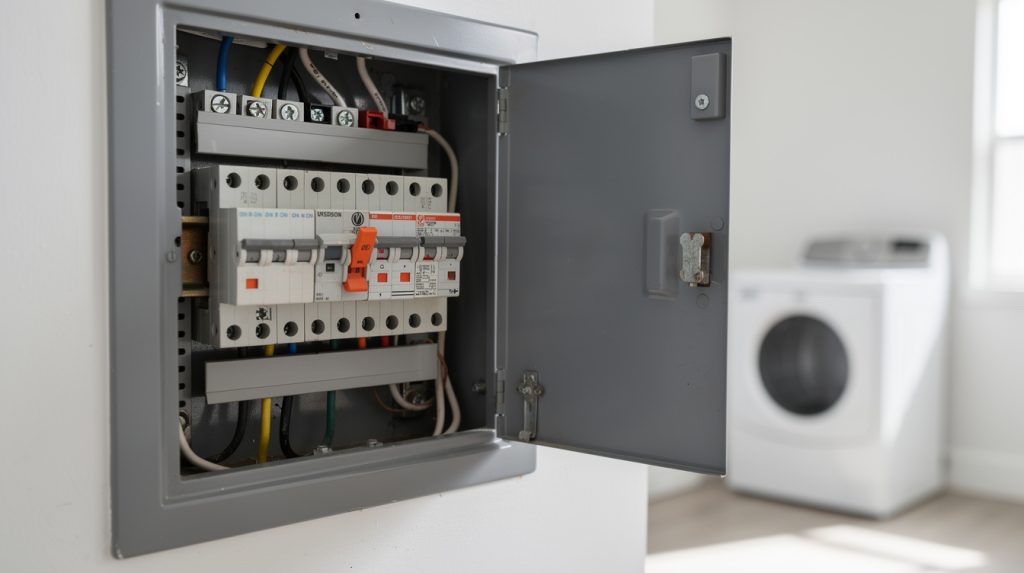
You throw in a load of towels, hit start, and twenty minutes later the laundry room goes quiet. You walk out to the panel, find the double breaker sitting halfway between on and off, flip it back, and the dryer runs again. For a while. Then it does the same thing next Tuesday.
A tripping breaker is not a nuisance to be managed with a monthly trip to the electrical panel. It’s a safety device doing exactly what it was designed to do: shutting off a circuit that is pulling more current than it should, or leaking current somewhere it shouldn’t go. Something in that system is failing, and the breaker is the only thing standing between it and a much worse outcome. Here’s how to read what your dryer is telling you.
One note before we start: everything below is about electric dryers. SkyBreeze doesn’t service gas appliances, and gas dryer repairs need a licensed gas technician.
First, Understand What You’re Working With
An electric dryer runs on a 240-volt circuit, which is different from almost everything else in your house. Standard outlets are 120 volts and run on a single hot wire. Your dryer gets two hot legs, each at 120 volts, and they work against each other to deliver 240 volts to the heating element. That’s why the breaker in your panel is a double breaker — two switches tied together with a common handle so both legs shut off at once.
The circuit is normally rated at 30 amps. The heating element alone typically draws around 20 to 25 amps when it’s on. The motor, drum light, and controls run on 120 volts, drawing a few amps more. Under normal operation you’re using most of that 30-amp budget but not exceeding it. There isn’t much headroom, which is exactly why a modest fault pushes the circuit over the edge.
Breakers trip for two different reasons, and it helps to know which you’re dealing with:
- Overcurrent — something is drawing more amps than the circuit is rated for. A heating element that has partially shorted, a motor with failing windings, or a blower wheel that’s jammed will all do this.
- Ground fault — current is escaping the intended path and running to the metal chassis or ground wire. A heating element coil sagging into the housing, a chafed wire, or moisture bridging a terminal will cause this.
You don’t need a meter to narrow this down. The timing of the trip tells you most of what you need to know.
Safety First — And This Part Isn’t Negotiable
Before you look at anything inside the dryer, go to the panel and switch the double breaker fully OFF. Not to the tripped middle position — all the way off. If your dryer plugs into a wall outlet, unplug it after killing the breaker, not before. And leave the breaker off the entire time the back panel is open.
Second rule, and it’s the important one: do not keep resetting a breaker that keeps tripping. Every reset sends full current back into a known fault. The breaker itself wears out from repeated tripping, and a worn breaker eventually stops tripping when it should. People sometimes take that as the problem “fixing itself.” It isn’t. That’s the safety device giving up.
If you smell burning plastic, see scorch marks around the outlet or cord, or the breaker feels hot to the touch, stop right there and call a licensed electrician before doing anything else.
What the Timing of the Trip Tells You
Pay attention to exactly when the breaker goes. This is the single most useful diagnostic you have, and it costs nothing.
It Trips the Instant You Reset It, With the Dryer Off
If the breaker won’t even stay on with the dryer sitting idle, the fault is a dead short — and it’s very likely in the wiring, the outlet, the cord, or the terminal block. It is not a control board or a timer issue. Unplug the dryer and reset the breaker. If it holds with the dryer unplugged, the fault is in the dryer or its cord. If it still trips with nothing plugged in, the problem is in the house wiring or the breaker itself, and that’s electrician territory.
It Trips as Soon as the Cycle Starts
This usually points at the motor. A motor with shorted windings or seized bearings pulls a huge inrush of current the instant it tries to turn. You’ll often hear a low hum or a brief grinding sound in the half-second before the breaker goes. A blower wheel packed solid with lint, or a foreign object wedged against the blower, can do the same thing by preventing the motor from spinning up.
A related clue: if your dryer had been making noise before this started, the bearings were probably already telling you. Our guide on what dryer noises actually mean covers the sounds that come before a motor gives out.
It Trips a Few Minutes In, Once Heat Kicks On
This is the most common pattern by far, and it points squarely at the heating element. The dryer starts fine on the motor alone, then the element energizes and the extra load exposes the fault. Nine times out of ten this is a heating element coil that has stretched, sagged, and made contact with the metal element housing — a direct path to ground the moment power hits it.
Heating elements are coiled nichrome wire suspended inside a metal can. Over years of heating and cooling, that wire elongates. Eventually a loop drops far enough to touch the can. Sometimes the coil breaks entirely and the two broken ends arc against the housing. Either way, you get a ground fault the instant the element is called for.
It Trips at the End of a Long Cycle, or Only on Big Loads
When the trip only happens after 40 minutes, or only when you’re drying towels and jeans, think heat buildup rather than a hard electrical fault. Restricted airflow makes the dryer cycle its element on and off constantly and lets internal temperatures climb. Hot components have higher resistance and draw differently, and a marginal connection that’s fine when cool can arc once everything is at temperature.
This is the pattern that most often traces back to a clogged vent. If your dryer has also been taking two cycles to dry one load, you almost certainly have a duct problem feeding the electrical one.
The Seven Things That Actually Cause It
1. A Shorted Heating Element
The number one cause, and worth checking first if the trip happens once heat kicks in. With the breaker off and the dryer unplugged, pull the rear access panel. On most models the element sits in a housing on the back or along one side. Look at the coil: you’re checking whether any loop has sagged into contact with the metal can, and whether any section looks broken, blistered, or has a bright spot where it arced.
If you have a multimeter and are comfortable with it, set it to the ohms setting and check resistance from each element terminal to the bare metal housing. A healthy element reads open — no continuity to ground at all. Any reading at all between a terminal and the housing means the element is shorted and needs replacing. Element resistance across its own two terminals should read somewhere around 8 to 12 ohms depending on the model; an open reading there means a broken element (which causes a no-heat problem, not a tripping one).
Elements are usually one of the more affordable dryer parts, and on many models the swap is genuinely straightforward. Just make sure you replace the element, not just the coil, unless the manufacturer sells the coil separately for your specific model.
2. A Failing Motor or Jammed Blower
Motors fail two ways. The windings degrade and short internally, which spikes current draw. Or the bearings seize, the motor stalls under load, and a stalled motor draws locked-rotor current — several times its normal draw — until something gives.
With power off, reach in and turn the blower wheel by hand. It should spin freely with a light drag. If it’s stiff, grinding, or won’t turn at all, you’ve found your fault. Also look for a sock, a coin, or a shredded dryer sheet wedged between the blower wheel and its housing. That happens more often than you’d guess, and it stalls the motor just as effectively as bad bearings.
3. A Damaged Power Cord or Burnt Terminal Block
The terminal block is where the cord’s three or four wires bolt onto the dryer. Those connections carry serious current, and if any bolt has worked loose over the years, the resulting resistance generates heat right at the connection. Heat degrades the insulation and the plastic block, and eventually you get arcing between terminals or from a terminal to the chassis.
With the breaker off and the dryer unplugged, remove the small cover over the terminal block on the back panel and look for: browned or melted plastic, green or white corrosion on the lugs, blackened wire ends, or a bolt you can turn with your fingers. Also run the whole length of the cord through your hands, checking for nicks, flat spots where the dryer was shoved back against it, or a plug with discolored blades.
A burnt terminal block is a real fire risk and needs replacing, not tightening. If the block itself is charred, replace the block and the cord together — the cord’s wire ends are almost always damaged too.
4. Moisture and Lint Bridging Terminals
This one is underrated, and it’s more of a Florida problem than most people realize. In a humid laundry room — especially a garage laundry in Tampa or Land O’ Lakes in August — fine lint absorbs moisture from the air and packs into every corner of the dryer’s interior. Damp lint is mildly conductive, and enough of it packed across two terminals or between a terminal and the chassis creates exactly the kind of leakage path a breaker is built to catch.
The tell is a trip that happens on humid days and not on dry ones, or one that appears right after a period when the dryer sat unused. The fix is a thorough vacuum of the dryer’s interior cavity with the panels off, paying particular attention to the area around the element housing and any terminal connections. It’s also a good reason to keep a garage laundry area as ventilated as you reasonably can.
5. A Weak or Aged Breaker
Breakers are mechanical devices with a finite life. Every trip stresses the internal bimetallic strip, and after enough cycles a 30-amp breaker starts tripping at 24 or 25 amps. At that point a perfectly healthy dryer trips it every time the element comes on.
You can suspect this when: the breaker is visibly older than the rest of the panel, it feels warm or loose in its slot, the dryer has been tripping since a period of frequent resets, or you’ve already checked the element, motor, cord, and vent and found nothing. Do not diagnose or replace this yourself. Panel work is for a licensed electrician, full stop.
6. A Shared or Overloaded Circuit, or DIY Wiring
A dryer circuit should serve exactly one thing: the dryer. If a previous owner or a well-meaning relative tapped that circuit for a garage outlet, a freezer, or shop equipment, the combined draw can exceed 30 amps whenever both loads run. This shows up as a maddeningly intermittent trip that seems to have nothing to do with the dryer.
Other wiring red flags: an outlet that doesn’t match the plug and has been “adapted,” an undersized wire gauge, a 4-prong cord jumpered onto a 3-prong setup incorrectly, or a neutral and ground bonded where they shouldn’t be. Any of these are electrician work. Getting them wrong turns a tripping breaker into an energized dryer cabinet.
7. Restricted Venting Causing Repeat Overheats
A blocked vent doesn’t directly trip a breaker, but it’s the underlying cause behind a lot of the faults above. When hot air can’t escape, the element housing runs far hotter than designed, and that heat accelerates coil sag, degrades wire insulation, and cooks connections. Fix the vent and you stop replacing elements every couple of years.
Pull the duct off the back and check the whole run, including the exterior hood flap. If you find packed lint, clean it thoroughly and consider replacing any flexible foil duct with rigid metal. A restricted vent also produces a hot or burning smell and long dry times, so you usually get warning before the electrical trouble starts.
A Sensible Order of Operations
- Note exactly when the trip happens. Write it down if it’s intermittent.
- Kill the breaker. Unplug the dryer. Reset the breaker with the dryer unplugged — does it hold?
- If it holds unplugged, the fault is in the dryer or cord. If not, call an electrician.
- Inspect the cord and terminal block for heat damage and loose bolts.
- Pull the rear panel. Vacuum out lint. Inspect the heating element coil for sag and contact.
- Spin the blower wheel by hand. Check for jams and rough bearings.
- Pull and inspect the vent duct all the way to the exterior hood.
- If everything checks out and it still trips, suspect the breaker or the branch wiring — electrician.
If you’d rather not open the back at all, that’s a completely reasonable position. A tech can go through the whole list in under an hour with a meter and know precisely which part failed. SkyBreeze Appliance Repair handles element, motor, terminal block, and thermostat work on every major electric dryer brand across Tampa, Wesley Chapel, Lutz, Land O’ Lakes, Shady Hills, Hudson, Dade City, Zephyrhills, and The Villages.
Where the Line Is Between an Appliance Tech and an Electrician
The split is cleaner than most people expect. Everything from the plug forward — cord, terminal block, element, motor, thermostats, wiring inside the cabinet — is appliance repair. Everything from the outlet back — the receptacle, the branch wiring, the breaker, the panel — is electrical work.
Call an electrician first if the breaker trips with the dryer unplugged, if the outlet or its cover shows heat damage, if the panel makes noise or smells warm, or if you have any reason to think the circuit was modified. Call an appliance tech if the fault follows the dryer and the outlet is clean and cool.
Keeping It From Coming Back
Most repeat breaker trips trace back to heat and lint, and both are manageable.
- Clean the lint screen every single load. Wash it with dish soap every few months to strip fabric-softener film.
- Clean the full vent run at least once a year, more if you have a long duct or a big household.
- Replace foil flex duct with rigid or semi-rigid metal, and keep the run as short and straight as you can.
- Vacuum the dryer’s interior cavity every year or two when you have a panel off anyway.
- Don’t shove the dryer hard against the wall — you crush the duct and pinch the cord in one move.
- Take intermittent trips seriously the first time. They almost never resolve on their own.
Some of this overlaps with basic dryer upkeep, which we cover in more depth in our guide on maintaining your dryer to prevent fire hazards. It’s the same maintenance either way — a well-vented, lint-free dryer draws less current, runs cooler, and stops surprising you at the panel.
The Short Version
A tripping breaker means a real fault, not a quirky dryer. Trips at power-up point to wiring or the cord. Trips at cycle start point to the motor or a jammed blower. Trips once heat comes on point to the heating element, which is the most common cause by a wide margin. Trips at the end of long cycles usually mean a blocked vent cooking the electricals.
Turn the breaker off, work through the list in order, and resist the urge to just keep flipping it back on. That breaker is doing its job. The goal is to make it so it never has to.