Refrigerator Running Constantly? 7 Reasons It Never Shuts Off
Have you noticed your refrigerator humming away around the clock lately? Maybe you walked into the kitchen at midnight for a glass of water and realized the fridge was running — again. While it’s normal for a refrigerator to cycle on and off throughout the day, one that runs constantly without ever taking a break is trying to tell you something. And here in Florida, where summer kitchen temperatures climb fast, that message is worth listening to before your energy bill — or your compressor — pays the price.
The good news? A refrigerator that runs nonstop usually has one of a handful of fixable causes. Let’s walk through them the way a technician would, starting with the simplest explanations and working toward the ones that need professional attention.
How Often Should a Refrigerator Actually Run?
A healthy refrigerator runs in cycles. The compressor kicks on, cools the interior down to the set temperature, and then shuts off until the temperature drifts back up. Depending on the model, ambient temperature, and how often the doors are opened, a typical refrigerator runs about 40 to 80 percent of the time. Modern high-efficiency models with inverter compressors run longer but at lower power, which can sound like constant running even when everything is fine.
So how do you know if there’s a real problem? Watch for these companion symptoms:
- The refrigerator never shuts off, even overnight when the kitchen is cool and the doors stay closed
- Your electric bill has crept up noticeably without another explanation
- The fresh food section feels warmer than usual even though the unit runs nonstop
- Frost is building up in the freezer, or the exterior cabinet feels hot to the touch
If one or more of those sounds familiar, keep reading — one of the causes below is almost certainly the culprit.
The 7 Most Common Reasons a Refrigerator Runs Constantly
1. Dirty Condenser Coils
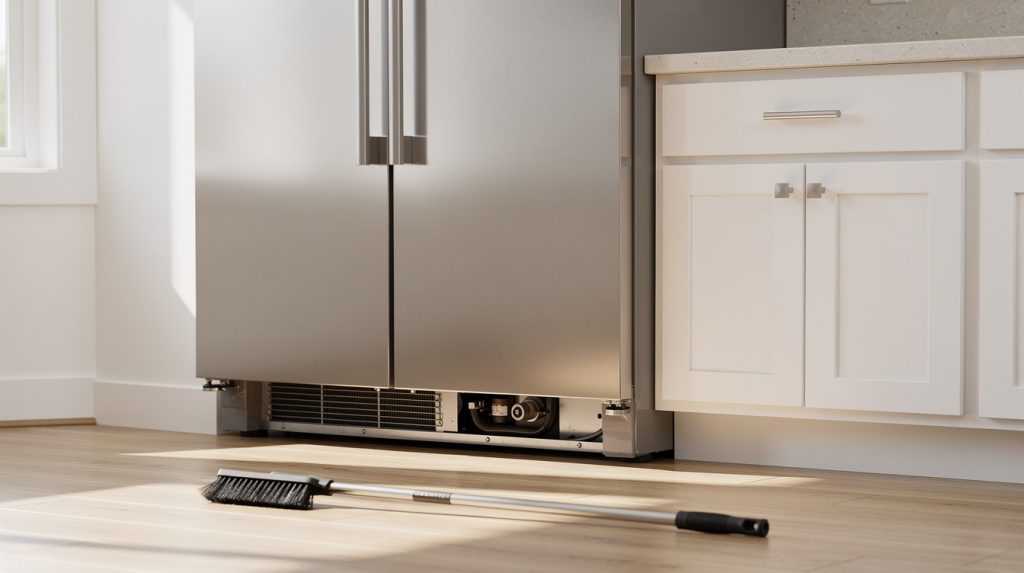
This is the number one cause we see in homes across Tampa, Wesley Chapel, and Land O’ Lakes — and the easiest to fix. The condenser coils, located underneath or behind your refrigerator, release the heat that’s been removed from the interior. When they’re coated in dust, pet hair, and kitchen grease, they can’t shed heat efficiently. The compressor compensates by running longer and longer, until eventually it’s running all the time.
Cleaning the coils takes about 15 minutes with a coil brush and a vacuum, and it can cut your refrigerator’s energy use significantly. We’ve written a complete walkthrough in our guide to cleaning refrigerator condenser coils — if you’ve never done it, start there. In Florida homes with pets, plan on doing this every six months.
2. The Kitchen Is Simply Too Hot
Refrigerators work harder when the room around them is warm, and Florida summers are merciless. If your kitchen regularly sits above 80°F — common in homes where the AC struggles in the afternoon, or in garages where second refrigerators often live — your fridge may legitimately need to run almost constantly just to hold temperature.
Check the clearance around the unit, too. A refrigerator pushed tight against the wall or boxed into cabinetry with no airflow can’t dissipate heat. Aim for at least an inch of space on the sides and a couple of inches behind. If your garage fridge runs nonstop every June through September, that’s a sign it’s operating outside its design conditions, and you may want to move it somewhere cooler.
3. Door Gaskets That No Longer Seal
The rubber gasket around each door is what keeps cold air in and humid Florida air out. When a gasket gets brittle, torn, or warped, warm moist air leaks in continuously — and the compressor runs continuously to fight it. You’ll often see condensation around the door edges or frost buildup inside the freezer when this is happening.
Try the dollar bill test: close the door on a bill and tug. If it slides out with no resistance, the seal is weak at that spot. Test several spots around each door. Replacement gaskets are model-specific and usually run $50–$100, and swapping one is a manageable DIY job on most models.
4. A Failing Defrost System
Your refrigerator automatically melts frost off its evaporator coils several times a day. If the defrost heater, defrost thermostat, or defrost timer fails, frost slowly builds up on the coils until they’re encased in ice. Ice-covered coils can’t absorb heat from the interior, so the compressor runs endlessly trying to reach a temperature it can never achieve.
The telltale sign: the freezer still feels cold, but the fresh food section gradually warms, all while the unit never stops running. If you open the freezer and see heavy frost on the back panel, the defrost system is the prime suspect. This repair involves electrical testing and is usually best handled by a professional — it’s one of the most common refrigerator repairs we perform across the Tampa Bay area.
5. The Thermostat or Thermistor Is Misreading
If the temperature sensor inside your refrigerator drifts out of calibration or fails outright, it can tell the control board the interior is warmer than it really is. The control board responds by running the compressor without pause. A clue here: if your food is freezing in the fresh food section while the unit runs constantly, the sensor is likely misreading. Our article on why refrigerators freeze food covers this failure mode in more detail.
6. Low Refrigerant from a Sealed System Leak
Less common, but serious: if the sealed cooling system develops a leak, the refrigerant charge drops and the system loses cooling capacity. The compressor runs nonstop trying to compensate, but the interior never gets quite cold enough. You might also notice the compressor area is unusually hot, or hear a faint hissing or gurgling.
Sealed system repairs require EPA-certified equipment and are expensive — this is the point where our repair vs. replace guide becomes essential reading, especially for refrigerators more than 10 years old.
7. An Overstuffed or Constantly Opened Refrigerator
Finally, the human factor. A refrigerator packed wall-to-wall blocks internal airflow, creating warm pockets the thermostat keeps chasing. And in busy households — especially during summer break when the kids are home raiding the fridge every twenty minutes — the doors may simply be open so often that the unit never gets a chance to rest. Neither of these is a malfunction, but both produce the same nonstop running and the same inflated power bill.
Step-by-Step: What to Do This Week
Here’s the order we’d suggest tackling it:
- Day 1: Pull the fridge out, unplug it, and clean the condenser coils thoroughly. Check clearance when you push it back.
- Day 1: Test the door gaskets with the dollar bill test and inspect them for cracks or warping.
- Day 2: Verify temperature settings: 37°F for the fresh food section, 0°F for the freezer. Give it 24 hours to stabilize.
- Day 3: Open the freezer and inspect the back panel for heavy frost. Listen near the compressor for hissing.
- Day 3: If the unit still runs constantly with clean coils, good seals, and correct settings, it’s time for a professional diagnosis.
What Constant Running Costs You
A refrigerator that should run 50 percent of the time but instead runs 100 percent of the time roughly doubles its energy consumption. For a typical full-size unit, that can mean an extra $10–$20 per month on your electric bill — real money over a Florida summer. But the bigger cost is wear: compressors are designed for cycling, and one that never rests fails years earlier than it should. A $100 repair today routinely prevents an $800 compressor failure (or a full replacement) down the road.
It’s the same principle we explain in our appliance lifespan guide: the difference between a refrigerator that lasts 10 years and one that lasts 18 usually comes down to how hard it had to work along the way.
Brand Notes Worth Knowing
Samsung and LG
Both brands use inverter-style compressors that legitimately run long, quiet, low-power cycles — so “always running” can be normal. The red flags on these models are frost buildup behind the freezer panel and warming fresh-food sections, both of which point to known defrost system weak spots.
Whirlpool, Maytag, and KitchenAid
On these sister brands, a failed defrost thermostat is a frequent cause of constant running. Parts are inexpensive and widely available, making this one of the more affordable professional repairs.
GE and Frigidaire
Aging thermistors and damper issues show up often on GE Profile and Frigidaire Gallery models. If your unit is 8+ years old and running nonstop, sensor drift is a strong candidate.
When to Call a Professional
If you’ve cleaned the coils, confirmed the seals, set the temperatures correctly, and the refrigerator still won’t take a break — or if you’ve spotted heavy frost, a hot cabinet, or warming food — it’s time for a diagnosis. The team at SkyBreeze Appliance Repair services refrigerators of every major brand across Tampa, Wesley Chapel, Lutz, Land O’ Lakes, Shady Hills, Hudson, Dade City, Zephyrhills, and The Villages, and most repairs are completed in a single visit with parts on the truck.
A constantly running refrigerator is your appliance working overtime to overcome a problem. Find the problem, fix it, and both your fridge and your electric bill get to relax.