Dishwasher Soap Dispenser Not Opening? Here’s What’s Going On
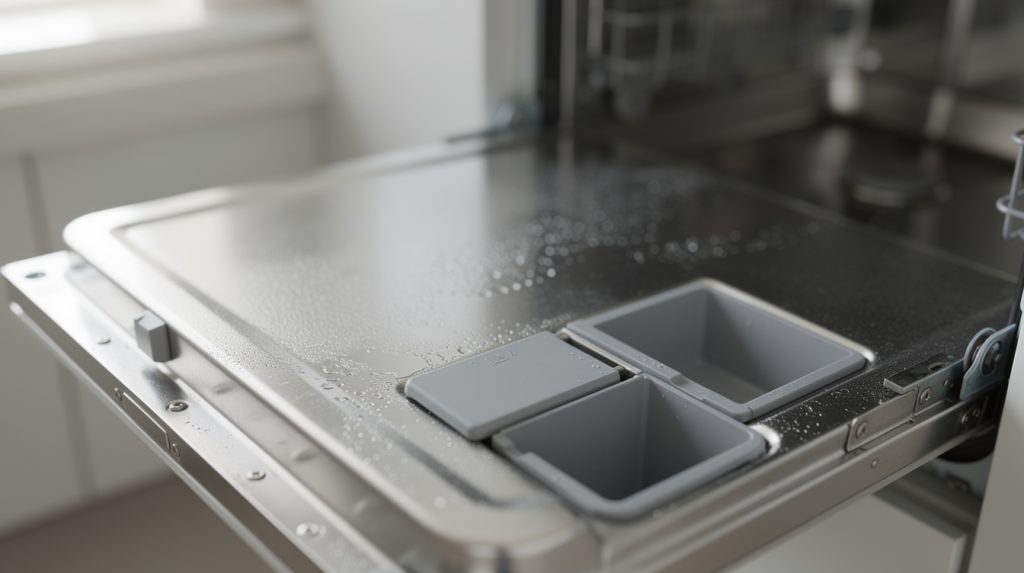
You open the dishwasher after a full cycle, and there it is: a little brick of detergent still sitting in the cup, or a pod glued to the bottom of the tub like a wad of gum. The dishes are wet, faintly gritty, and clearly did not get washed with soap. It’s one of the most common calls we get, and the good news is that maybe half the time you can sort it out yourself in twenty minutes with a toothbrush and a cup of hot water.
But before you order a part or start prying at plastic, you need to answer one question correctly. It changes everything about what comes next, and almost everybody gets it wrong on the first guess.
First: Did the Door Never Open, or Did It Open and Nothing Happened?
These are two completely different failures with two completely different fix lists. Sorting them out takes ten seconds of looking.
The dispenser door is still latched shut
Run your finger across the front of the dispenser. If the little flap is still closed and the detergent inside is dry or barely damp, the door never released. That’s a mechanical or electrical problem: a stuck latch, a broken spring, a dead wax motor, a bad control board signal, or something physically blocking the door from swinging.
The dispenser door is hanging open but detergent is left behind
If the flap is open, hanging loose, and there’s a crusty ring of powder in the cup or a slimy film of gel in the corners, the mechanism did its job. The detergent just didn’t dissolve or didn’t get rinsed out. That points to water temperature, water pressure, a blocked spray arm, caked-up detergent, or the pod landing somewhere it shouldn’t have.
People chase the wrong problem for weeks because they skip this step. Look at the door first. Everything below is organized around that answer.
When the Door Opened but the Detergent Didn’t Dissolve
This is the more common of the two, and it’s almost always fixable without tools.
Your water is arriving too cold
Dishwasher detergent is designed to dissolve at roughly 120°F. Below about 110°F, powdered detergent turns pasty instead of dissolving, and pod film goes gummy and sticks to whatever it touches. Most dishwashers do have a heating element, but a lot of modern energy-efficient models heat the water slowly during the cycle, and the main wash may start before the water is fully up to temperature.
The easy test: run the kitchen sink on hot until it’s genuinely hot, then start the dishwasher. That fills the machine with hot water from the first second instead of the cold slug that’s been sitting in the supply line. If your problem disappears, you found it. Also check the temperature setting on your water heater — 120°F is the sweet spot, and a lot of Florida homes have it dialed way back.
The detergent is caked, clumped, or old
Powdered and pod detergents have a real shelf life, roughly 12 to 15 months, and they die much faster in humid air. If you keep a box or a tub under the sink in Tampa or Wesley Chapel, you’re storing it in the most humid cabinet in the house. Moisture creeps in, the powder cakes into a solid disc, and pods fuse into a single blob that won’t separate cleanly.
- Squeeze a pod. It should be soft and slippery, not hard or tacky.
- Dump a spoonful of powder into a glass of hot water. If it clumps and sinks instead of clouding up, throw the box out.
- Store detergent in a sealed container somewhere dry, not under the sink next to the disposal.
- Buy smaller boxes more often. A giant warehouse-club tub is false economy in this climate.
You loaded the pod into the wrong compartment
Most dishwashers have two openings on the door panel: the main detergent cup with the hinged lid, and a smaller pre-wash well that’s usually just an open dimple. Some also have a rinse-aid reservoir with a screw cap or a flip-up plug, and that one catches people constantly. If you’ve been dropping pods into a round capped reservoir, that’s the rinse-aid tank, and it’s not going to open at all — it’s designed to meter out liquid slowly through a tiny port.
The detergent cup is the one with a spring-loaded flap and a latch. If yours is unlabeled, open the door, find the flap that clicks shut and pops when you press the release, and use that one. Pods go in the closed cup, not loose in the tub — unless your manual specifically says otherwise.
A tall item is blocking the spray
Even with the door open and the detergent released, the water has to physically reach the cup to wash it out. A tall pot lid, a baking sheet, or an oversized platter in the lower rack front row will shadow the dispenser and leave the detergent sitting there in a puddle. This overlaps heavily with general cleaning complaints — if you’re also seeing food residue, our guide on loading a dishwasher for the best clean covers the layout rules that solve both problems at once.
When the Door Never Opened at All
Now we’re in mechanical territory. Unplug the dishwasher or flip its breaker before you go poking at anything on the inner door panel. It only takes a second and it removes any chance of the mechanism firing while your fingers are in it.
Something physically blocked the door from swinging
This is the single most common cause, and it’s the one nobody believes until they check. The dispenser door swings out and down into the tub. Anything sitting in its arc will stop it cold. Cutting boards leaned against the door, tall Tupperware lids, a wooden spoon handle poking through the lower rack, a large mixing bowl — all classic offenders.
Close the empty dishwasher door most of the way and look at where the dispenser flap would swing. Then load it the way you normally do and look again. If anything is within about three inches of the front of the dispenser, that’s your answer. Cutting boards belong along the far side or back edge of the lower rack, never up against the door.
Detergent residue has cemented the latch shut
This is the big Florida one. Hard water is the default across most of Hillsborough and Pasco County, and if you’re on a well out in Land O’ Lakes, Shady Hills, or Hudson, the mineral load is often higher still. Calcium and magnesium combine with detergent to form a chalky, slightly waxy scale that builds up around the latch tab and the door edge. It doesn’t look like much — a thin white haze — but it’s enough to keep a light spring-loaded latch from releasing.
If you’re also getting cloudy glassware, that’s the same mineral doing the same thing on your dishes, and it’s worth reading our breakdown of white film on glasses and the broader piece on how Florida hard water damages appliances. Fixing the water fixes several problems at once.
The latch spring is broken or the hinge is cracked
Press the dispenser release manually with the power off. The door should snap open crisply, and when you push it closed it should click and stay put. Two bad signs:
- It flops open and won’t stay latched. The spring has lost tension or snapped. The dispenser will dump detergent during pre-wash instead of the main wash, which mimics “no soap” symptoms perfectly.
- It sticks, binds, or moves unevenly. Look at the hinge pins at either end of the flap. Plastic hinges crack from years of heat cycling, and a cracked pin lets the door cock sideways and jam in its track.
Neither is repairable on its own. The whole dispenser assembly comes as one unit, and on most brands it’s a reasonable part in the $30 to $80 range plus labor.
The wax motor or solenoid failed
Here’s how the release actually works. Most dishwashers use one of two mechanisms. A wax motor is a small cylinder containing a wax pellet and a heating element; when the control board sends voltage, the wax expands over about 30 to 45 seconds, pushing a plunger that trips the latch. A solenoid does the same thing instantly with an electromagnet.
Wax motors are the more common failure. They wear out gradually, and the classic symptom is intermittent: works fine on a long heavy cycle, fails on a quick wash because the wax doesn’t have time to fully expand. If your dispenser opens on some cycles and not others, put your money on the wax motor.
Testing one means pulling the inner door panel, and the check is a resistance reading across the terminals — typically somewhere in the 1,000 to 2,000 ohm range depending on the model, with an open circuit meaning it’s dead. If that sentence made you uneasy, that’s a completely reasonable place to stop. The dishwasher repair team at SkyBreeze does this diagnosis regularly, and we’d rather run the meter for you than have you take the door panel apart and discover the insulation batting comes out with it.
The control board isn’t sending the signal
Less common, but real. If the wax motor tests good and the latch moves freely, the board may not be firing the dispenser at the right point in the cycle. Sometimes this shows up alongside other timing oddities — a cycle that runs unusually short, or a machine that skips the heated dry. Before assuming board failure, try a full reset: kill power at the breaker for five full minutes, then restore. Our guide on resetting any appliance walks through the sequence by brand. A surprising number of dispenser timing faults are just a confused board, and after our summer storm season we see a lot of them.
How to Clean the Dispenser Properly
Do this every couple of months and you’ll head off most latch problems before they start. Power off first.
- Scrape out any hardened detergent with a wooden or plastic utensil. No screwdrivers — you’ll gouge the plastic and give residue a place to grip.
- Soak a rag in undiluted white vinegar and drape it over the dispenser area for 15 minutes to soften mineral scale.
- Scrub the cup, the flap edges, the latch tab, and the recess the latch drops into with an old toothbrush. The latch tab is the part everyone skips and the part that actually matters.
- Work the door open and closed by hand ten or twelve times. It should feel smooth and consistent, with a clean click at the end.
- Wipe out the vinegar, dry the cup completely, and restore power.
While you’re in there, pull the lower spray arm and check that the holes aren’t plugged with scale, and clean the filter at the bottom of the tub. Keeping ahead of buildup is most of what’s in our guide to extending dishwasher life.
Confirming the Latch Travels Freely
With the machine unplugged and the door open flat, press the release and watch the flap the whole way through its travel. You want to see three things: it starts moving immediately with light pressure, it swings its full arc without hesitating or scraping, and it stops where it’s supposed to instead of flopping past. Then push it closed slowly. The latch should catch with a clean click, and a light tug shouldn’t pop it back open.
If all three check out, your mechanism is fine and the problem is electrical or thermal — the wax motor, the board, or water temperature. If any of the three feels wrong, it’s the dispenser assembly.
Repair or Replace the Dispenser Assembly
The part itself is usually cheap. Labor is the variable, because on many models the inner door panel has to come off, which means removing a row of screws around the perimeter, separating the panel without tearing the insulation, and reseating the door gasket correctly on the way back. On some brands it’s a 30-minute job; on others it’s closer to 90 minutes with a fussy wiring harness.
Our rough guidance: if the dishwasher is under eight years old and otherwise washing well, replace the dispenser without hesitation. If it’s past ten, already leaking or draining poorly, and this is the third repair in two years, put the money toward a new machine instead. We laid out the math in the repair vs. replace cost guide, and the short version is that stacking repairs on a decade-old machine rarely pays off.
When to Stop and Call Someone
Call a tech if the dispenser fails intermittently across cycles, if you’re seeing burn marks or melted plastic around the mechanism, if the door panel needs to come apart to reach the wax motor, or if the dispenser problem showed up alongside other symptoms like the machine not draining or not starting reliably. Multiple symptoms at once usually means one shared cause, and chasing them one at a time wastes money.
If you’re anywhere around Tampa, Lutz, Zephyrhills, Dade City, or The Villages and the toothbrush-and-vinegar routine didn’t do it, SkyBreeze Appliance Repair can diagnose the dispenser circuit and have the assembly swapped in a single visit. We keep the common wax motors and dispenser units on the truck, so it usually doesn’t turn into a two-trip job.