Top-Load vs Front-Load Washers: Which One Actually Lasts Longer?
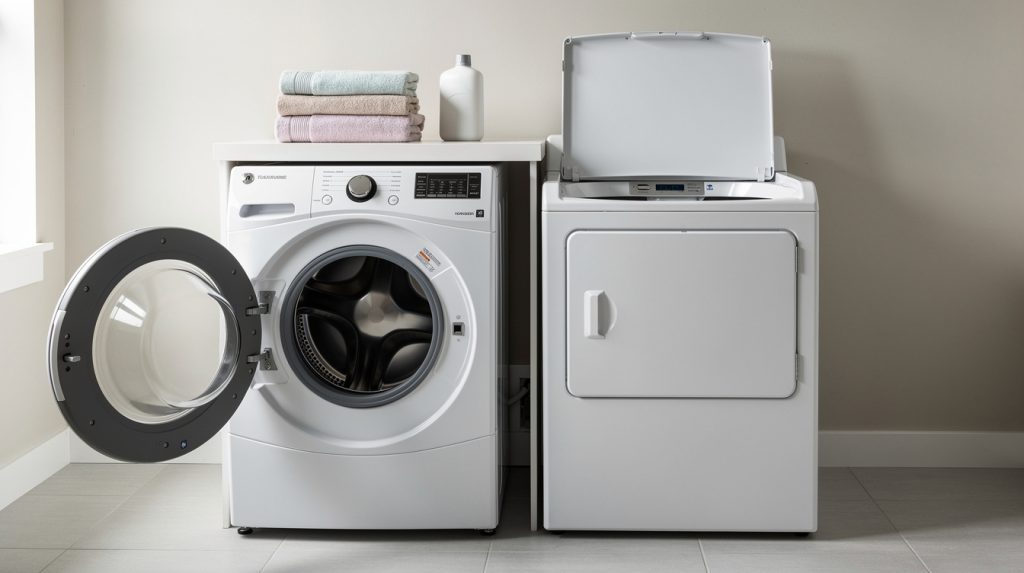
Ask ten people which washer lasts longer and you’ll get ten confident answers, most of them borrowed from a neighbor’s bad experience in 2013. The honest version is messier. Both designs can run 12 years. Both can die at year 6. What actually decides it is which parts wear out first, how expensive those parts are to reach, and whether the machine gets treated well in the meantime.
We open these things up every week across Tampa, Wesley Chapel, Land O’ Lakes and out toward Dade City, so this comparison comes from what’s actually on the repair invoice — not from a spec sheet. Here’s how each design works, what breaks on each one, what those repairs realistically cost, and how to pick the one that fits your house.
The three machines people are actually choosing between
“Top-load vs front-load” is really a three-way decision, because top-loaders split into two very different machines that share a cabinet shape and nothing else.
Front-load (horizontal axis)
The drum sits on its side and tumbles clothes through a shallow pool of water, lifting and dropping them against the baffles. Gravity does the agitating. Because it never has to fill above the drum’s lowest point, it uses roughly 12 to 20 gallons per load compared to 25 to 40 for an older agitator machine. Spin speeds run 1,000 to 1,400 RPM, which pulls a lot more water out before the load ever hits the dryer.
Agitator top-load (the traditional one)
The tall post in the middle twists back and forth about 60 times a minute, dragging clothes through a full tub of water. It’s mechanically simple, brutally effective on mud and grass, and hard on fabric. Spin speeds are usually 600 to 700 RPM. These are still sold new, and plenty of people specifically hunt them down.
High-efficiency impeller top-load (no agitator)
Instead of a post, there’s a low cone or disc in the bottom of the tub that spins and rocks, sliding clothes against each other. It uses less water than an agitator model, holds a king comforter, and spins around 800 to 1,100 RPM. It’s the compromise machine — and mechanically it’s the most complicated of the three, which matters when we get to repairs.
Water, energy, and what that means on a Florida utility bill
Front-loaders win on water, and it isn’t close. A front-loader running four loads a week uses roughly 3,000 gallons less per year than a full-fill agitator machine. Impeller top-loaders land in between.
The bigger savings is hiding somewhere else, though: the dryer. A 1,300 RPM front-load spin leaves clothes noticeably drier than a 650 RPM top-load spin. That’s often 10 to 15 minutes shaved off every dryer cycle, and the dryer is the far hungrier appliance. If your dryer already runs long, it’s worth ruling out other causes first — our guide on why a dryer takes too long to dry covers the vent and airflow issues that mimic a weak spin.
One local wrinkle: a lot of homes in Pasco and Hernando counties run on well water or hard municipal water, and hard water hurts low-water machines more than high-water ones. Less water means less dilution, so detergent and mineral residue concentrate. Scale builds on heating elements and inside the outer tub. If you’ve got white crust on the fixtures, read up on how Florida hard water damages appliances before you assume your new washer is defective.
Cleaning performance: it depends what you’re washing
Front-loaders clean better on most household laundry. The tumbling action works detergent through the fabric rather than just swirling it around, and the higher spin extraction means less detergent residue left behind. Independent testing has favored front-loaders on stain removal for years, and that matches what we see — front-load owners complain about smells, not about dirty clothes.
Agitator top-loaders are still the pick for genuinely filthy work clothes. Landscaping crews, mechanics, anyone coming home covered in Florida clay — that mechanical scrubbing moves grit out of fabric fast. The tradeoff is real wear. Agitators pill knits, stretch collars, and eat the occasional bra underwire.
Impeller top-loaders are the weakest cleaners of the three when overloaded, which is most of the time. They need room for clothes to slide against each other. Pack the tub and items in the center never move, coming out with dry patches. Fill the tub loosely to about three-quarters and they do fine.
Cycle times, and why the “normal” cycle got so long
An agitator top-loader finishes a normal load in 35 to 50 minutes. A front-loader on its normal eco cycle can run 75 to 110 minutes. That surprises people badly.
The length isn’t padding. Efficiency standards are measured on the default cycle, so manufacturers stretch it out — less water, more soak time, longer tumble to compensate. Almost every front-loader has a faster cycle hiding one dial position away, often called Quick Wash or Express, running 25 to 40 minutes and perfectly fine for lightly worn clothes. If nobody in the house ever learns that, the machine feels slow for a decade.
What actually fails on a front-loader
This is the part that decides the “lasts longer” argument. Every design has a short list of parts that show up on invoices over and over.
Door boot seal
The rubber bellows between the door and the drum is the number one front-load complaint. It traps water, lint, hair and detergent sludge in its folds, then grows black mildew. In a Florida laundry room that stays 78 degrees and humid year-round, this happens faster than it does up north. A boot replacement runs roughly $200 to $350 installed depending on model. It’s preventable — more on that below.
Tub bearings
The expensive one. Bearings sit behind the outer tub and support the shaft the drum spins on. When they go, you get a low airplane-takeoff roar during spin that gets louder each week, and eventually drum wobble. On many machines the bearings aren’t sold separately — you replace the whole outer tub assembly, and the bill lands between $450 and $800. On a seven-year-old washer that’s usually the end of the conversation. Our repair vs replace cost guide walks through where that line sits.
Bearings usually fail because the door boot leaked water down onto them first, or because years of unbalanced loads hammered them. Which means the cheap maintenance item protects the expensive one.
Drain pump
Front-load pumps sit low and catch everything the drum lets through: coins, hairpins, bra wires, a shocking volume of screws. Most have an access panel at the front bottom with a filter you’re supposed to clean quarterly. Almost nobody does. A clogged pump throws a drain error and mimics a dead pump. Pump replacement is a modest repair, usually $180 to $300. If yours is stalling out, start with the drain troubleshooting steps here — sometimes it’s just the filter.
Spider arm
The three-legged aluminum casting that bolts the drum to the shaft. Detergent residue plus water plus aluminum equals corrosion, and eventually a leg cracks. Symptom: violent banging on spin that no amount of leveling fixes. Cost is similar to bearings, because you’re that deep in anyway. Overdosing detergent is the main accelerator — high-efficiency machines need about a tablespoon, not a capful.
What actually fails on an agitator top-loader
Transmission and clutch
The gearbox that converts motor rotation into that back-and-forth agitation is the classic failure. You’ll hear grinding during wash, or the agitator turns weakly, or it fills and drains but never really agitates. Transmission jobs run $300 to $500 and on machines past eight years old they’re often not worth it.
The clutch, which manages the handoff between agitate and spin, wears its friction lining down and starts slipping. Symptom: the tub spins slowly or the load comes out soaking. It’s usually a cheaper fix than the transmission, but reaching it means the same teardown.
Lid switch
Cheapest common failure on the whole list. The machine thinks the lid is open, so it fills and agitates but refuses to spin. Part is often under $40. If your washer fills fine and then just sits there, the spin-failure walkthrough covers this and five other causes worth checking before you call anyone.
Everything else
Agitator dogs (the little plastic ratchet cams inside the agitator) wear smooth and the top half stops driving clothes downward — a $15 part, ten minute job. Water inlet valves clog with mineral scale. Drive belts stretch. These are all cheap, accessible repairs, and that accessibility is the agitator machine’s real strength.
What actually fails on an impeller top-loader
These are direct-drive machines, which sounds like fewer failure points and mostly isn’t.
The shifter assembly — the actuator that locks the basket to the drive for spin and releases it for wash — is the signature failure. It’s a small motor and a plastic cam, and when it fails the machine washes but won’t spin, usually throwing a shifter or basket-speed error. Part cost is moderate, labor is straightforward, so figure $250 to $400. On some models it’s a known weak point that shows up around year five.
Bearings fail here too, and like front-loaders the fix means splitting the tub. Suspension rods — the four damping struts holding the tub — lose their internal friction and let the tub bang the cabinet. That’s the machine that walks across the laundry room floor. Rods are cheap and always replaced as a set of four, typically $200 to $300 installed. If yours is dancing, the shaking and vibrating guide helps you tell worn rods from a simple leveling problem.
Whichever machine you have, if it’s grinding, leaking, or refusing to spin, the technicians at SkyBreeze Appliance Repair work on all three designs and can usually tell from a description over the phone whether you’re looking at a $150 fix or a $700 one.
The mildew problem, and why Florida makes it worse
Front-loaders get a bad reputation for smell. It’s earned, but it’s also almost entirely preventable, and it has nothing to do with build quality.
The door seals watertight, which means when the cycle ends the drum is a warm, damp, sealed box. Add detergent residue and lint, and mold has everything it needs. In a Tampa summer with the laundry room sitting at 55% humidity, colonies establish in days.
What actually works:
- Leave the door cracked open between loads. This single habit prevents most of it. Same for the detergent dispenser drawer.
- Wipe the boot dry once a week. Pull back the folds — that’s where the water pools — and run a dry towel through.
- Use one tablespoon of HE detergent. Not a capful. Excess suds don’t rinse out and become mold food.
- Skip liquid fabric softener or use it sparingly. It coats the boot and dispenser with a waxy film that holds moisture.
- Run a tub-clean cycle monthly with an empty drum and either a washer cleaning tablet or two cups of white vinegar.
- Clean the drain pump filter quarterly. Standing water there smells and it’s five minutes of work.
Top-loaders aren’t immune, especially impeller models where water sits under the basket. If yours has already turned, this odor removal guide gets into the deep-clean steps. Before any hands-on work, unplug the machine and shut off both supply valves. And if you find water under the machine rather than just smell, stop and get eyes on it — a slow leak into the base is how bearings die.
Noise, vibration, pedestals, and where the machine lives
Front-loaders are quieter during wash — no clanking agitator — but louder during spin, because 1,400 RPM has to go somewhere. On a second-floor laundry room with a wood subfloor, that spin can shake the whole house. On a concrete slab, which most Florida homes have, it’s a non-issue. Leveling matters enormously either way. All four feet firm, no rocking, checked with an actual level.
Front-loaders stack, which top-loaders can’t. In a townhouse closet or a converted pantry, that alone decides it. Pedestals raise the machine 12 to 15 inches so you’re not bending to floor level, and they run $250 to $350 each — real money for a drawer and some height. They also raise the center of gravity, so leveling gets more important, not less.
Top-loaders need overhead clearance for the lid but no swing space in front. Front-loaders need three feet of clear floor for the door. Measure before you buy — we’ve seen doors that won’t open past the opposite wall.
Accessibility and daily use
This gets underweighted and shouldn’t. Bending to load a front-loader is genuinely hard on bad knees, backs, and hips. If someone in the house has mobility limits, a top-loader at counter height is the better machine regardless of what the efficiency numbers say. Conversely, top-loaders require reaching down into a deep tub, which is awkward for shorter people and anyone with shoulder issues.
Practical points: front-loaders let you add a forgotten sock mid-cycle only during the first few minutes, before the door locks. Top-loaders let you toss things in almost anytime. Front-loaders can’t be used to soak a garment overnight in a tub of water. Small stuff, but it’s the stuff you live with.
So which one actually lasts longer?
Averages put both around 10 to 13 years, which is a useless answer on its own. The useful version:
The agitator top-loader has the longest realistic service life, not because it’s better built but because its failures are cheap and fixable. Lid switches, belts, agitator dogs, inlet valves — all accessible, all affordable. People keep 15-year-old agitator machines running because each repair is $150, not $600.
The front-loader has the best odds of a trouble-free first decade if it’s maintained, and the worst outcome if it isn’t. Neglect the boot and the filter and you’re buying bearings at year seven. Wipe it down and leave the door open and it’ll outrun the top-loader on cleaning and water use the whole time.
The impeller top-loader is the middle option in every way, including reliability. The shifter assembly is a real weak point, but the machine avoids the mildew problem and handles bulky items well.
Buy this if…
- Buy a front-loader if you need to stack, you do a lot of laundry and want the water and dryer savings, you’ll actually leave the door open, and nobody in the house struggles with bending.
- Buy an agitator top-loader if you want the simplest, cheapest-to-fix machine, you wash genuinely dirty work clothes, you hate long cycles, or you plan to keep it 15 years and repair it as it goes.
- Buy an impeller top-loader if you want top-load convenience with better efficiency and room for comforters, and you’re willing to load it loosely.
Whatever you choose, buy the simplest model in the lineup that has the features you’ll use. Touchscreens, WiFi and steam add failure points and repair cost without adding years. And before you replace anything, get a diagnosis — plenty of “dead” washers are a $40 switch. If you’re in Tampa, Wesley Chapel, Lutz, Land O’ Lakes, Hudson, Zephyrhills, Dade City or The Villages, SkyBreeze Appliance Repair can tell you what’s actually wrong before you spend $1,200 you might not need to.
Turn off the water supply valves when you’re away for more than a few days, learn the quick-wash cycle, and check the basic maintenance routine twice a year. That’s most of the difference between a machine that lasts eight years and one that lasts fourteen.